
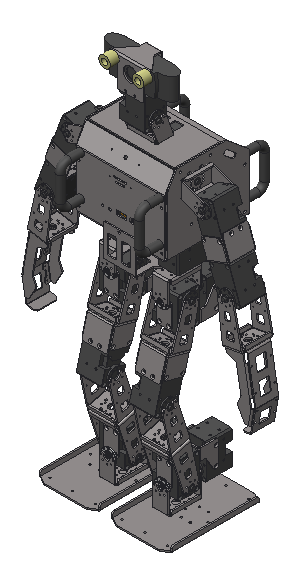
ROBOTIS OP3
ROBOTIS's open humanoid research platform — the robot that plays in RoboCup demos: twenty Dynamixel servos on one daisy-chained bus, an OpenCR board running them, and a small PC for a brain. Half a metre tall, fully documented in the ROBOTIS e-Manual.
Spec
| Actuators | 20× XM430-W350-R Dynamixel servos — legs 6 each, arms 3 each, head 2 |
|---|---|
| Battery | LiPo 3-cell, 11.1 V, 3300 mAh (current e-Manual; earlier ROBOTIS pages list 1800 mAh) |
| Computing | Intel NUC (i3) + OpenCR sub-controller; Logitech C920 camera |
| Footprint | ESTIMATED — ROBOTIS does not publish a standing footprint; the spec's 0.20 × 0.13 m is an estimate and is labeled as one |
| Height | ~510 mm (e-Manual, including the head camera) |
| Stall torque | 3.8 N·m at 11.1 V (XM430-W350 e-Manual page; documented input 10.0–14.8 V) |
| Weight | ~3.5 kg without the skin cover (e-Manual) |
examples/robotis-op3.jsonHeight, weight, DOF, actuator model and battery from the ROBOTIS e-Manual OP3 introduction (the current e-Manual lists a 3300 mAh battery; older ROBOTIS material says 1800 mAh — the current figure is used and the change is noted). Stall torque and voltage range from the e-Manual's XM430-W350 page. The DOF split (legs 6 each, arms 3 each, head 2) is the e-Manual's 20-DOF layout as also published in RoboCup materials. ROBOTIS publishes no standing footprint: the spec's length and width are ESTIMATED from the robot's proportions and are labeled ESTIMATED everywhere they appear.Imported specimen
Imported specimen — source: robot_descriptions (upstream: deepmind/mujoco_menagerie), license: Apache-2.0, imported 2026-10-29.
| Bodies | 21 (21 with inertial data) |
|---|---|
| Joints | 21 (1 free, 20 hinge) |
| Actuators | 20 |
| Degrees of freedom | 20 |
| Total mass (description inertials) | 3.14747 kg |
| Root body mass | 1.34928 kg |
Parsed from the MJCF at the pinned upstream commit: body/inertial elements under <worldbody>, joint elements (the <default> class stub excluded), the root body's <freejoint/> and the <actuator> list. Full record: catalog/specimens/robotis-op3.json (upstream MJCF robotis_op3/op3.xml at commit feadf76d, via robot_descriptions 3.3.0 (Python package), module robot_descriptions.op3_mj_description).
An import is provenance, not a verdict: this entry stays Not gated, and no parts kit is defined for it.
GateA pass/fail test in the Gazebo simulator: the twin drives 1 m, turns 90° and stops, and the result is measured against where it really went. runs
The motion gate covers ground robots today. This class has no gate yet, so there is no verdict to show — the note below says why, in the entry's own words.
No recorded gate runs yet. This robot has no verdict until one is measured.
Static stability check
A computation from this robot's spec — support-polygon statics, not a simulation run and not a gate verdict. It grades how far the robot can tip before its centre of mass passes over its feet. The gate status above is unchanged by it: this robot is still not gated.
| Grade | UNSTABLE |
|---|---|
| Static tip-over angle (weakest direction) | 2.7° — backward |
| Weakest tip margin | 13 mm from the centre-of-mass projection to the support-polygon edge |
| Margin as share of the body's half-extent | 20% |
| Centre-of-mass height | 0.281 m — ASSUMED at 55% of standing height (printed in the report's assumptions, never buried) |
| Thresholds (v1, printed on the report) | tip angle ≥ 20° STABLE · 10–20° MARGINAL · < 10° UNSTABLE |
Report: catalog/stability-reports/robotis-op3.json · checked 2026-10-26 · reproduce with robotforge stability examples/robotis-op3.json
How it was computed
Support-polygon statics from the spec's declared dimensions: convex hull of the foot contacts, weakest-direction distance from the centre-of-mass projection to a polygon edge, tip-over angle atan(margin / CoM height). No simulation, no motion — a computation, not a gate run.
Support model: Two feet in double support, each a rectangle 0.059 × 0.026 m (length 0.115 × standing height, width 0.05 × height), centred 0.032 × height ahead of the ankle line at ±0.22 × body width — the take-apart viewer's proportions; the spec publishes no foot dimensions.
| Direction | Margin | Tip angle |
|---|---|---|
| to the right | 57 mm | 11.4° |
| forward | 46 mm | 9.2° |
| to the left | 57 mm | 11.4° |
| backward | 13 mm | 2.7° |
Assumptions (all of them, as printed in the report):
- Foot size is derived from standing height with the viewer's proportions; it is not a published dimension.
- Double support: both feet flat on the ground. A humanoid in single support, or mid-step, is a dynamics problem this check does not model.
- Centre of mass sits horizontally at the centre of the body footprint.
- CoM height is ASSUMED at 55% of standing height — the spec declares no CoM height.
- Flat, level ground; rigid body; no payload.
HarnessThe robot’s wiring. The harness check adds up current on each power rail and flags wires that are too thin or rails that are overloaded. checks
Electrical checks over this robot's documented wiring. Not a simulation; the headline is counts, never a blanket pass.
2 checked clean · 0 with warnings · 0 with errors · 1 partial · 7 not checked · missing data: current_a for motors ×5, cable.gauge_awg ×4, cable.length_mm ×2
Check-by-check counts and missing data
| Check | Checked | Partial | Not checked |
|---|---|---|---|
| voltage drop | 0 | 0 | 2 |
| ampacity | 0 | 0 | 2 |
| logic levels | 0 | 0 | 1 |
| rail budget | 0 | 1 | 1 |
| connector match | 2 | 0 | 1 |
Findings: none — the inputs that could be checked raised nothing. That is not the same as everything being checked; the counts above say how much was.
Missing data — the datasheets still to hunt. A check that could not run says what it needs:
| Missing input | Blocks | Needed by |
|---|---|---|
current_a for motors | 5 | battery -> opencr, opencr -> motors, opencr rail |
cable.gauge_awg | 4 | battery -> opencr, opencr -> motors |
cable.length_mm | 2 | battery -> opencr, opencr -> motors |
connector at both ends (connector_from / connector_to) | 1 | battery -> opencr |
current_a for opencr | 1 | battery rail |
logic_v for motors | 1 | opencr -> motors |
logic_v for opencr | 1 | opencr -> motors |
rated output current for battery | 1 | battery rail |
Report: catalog/harness-reports/robotis-op3.json · checked 2026-10-27 · reproduce with robotforge harness examples/robotis-op3.json
Take it apart
This viewer derives a schematic take-apart straight from the spec's numbers — the same one-derivation rule as the ground kits — flat views, or in 3D with the toggle. It is a schematic of the real robot's layout, not a printable kit: robotforge cad kits cover ground robots only today. Click any part.
examples/robotis-op3.json…Parts kit
The take-apart kit robotforge cad generates from this robot's spec: every part the generator defines, what it does, and the parameters worth tweaking with the values this robot's kit ships with. Each parameter carries the generator's own source label — from spec numbers come out of the spec, derived numbers are computed from them, and assumption numbers are typical values the spec does not carry.
No take-apart kit is defined for this robot yet — the kit generator builds kits for wheeled ground robots from the spec's wheel block, and this spec has no wheels.
Reproduce it
Run these from a clone of the repository. The twin, CAD kit and motion gate (urdf / cad / run-gate) cover ground robots today, so they are not listed here.
robotforge validate examples/robotis-op3.json
robotforge stability examples/robotis-op3.json
robotforge catalog robot 10
robotforge harness examples/robotis-op3.json